Everything You Need To Know About Drum Notation
At Music House School Of Music, we understand that the key to exploring the world of rhythm is understanding drum notation. While taking drum lessons does help you in that regard, it’s best to start by understanding the basics of drum scores and sheet music. This means learning the language of drumming. Just like you have certain letters in English, drum notation has its alphabet made up of different symbols.
Picture yourself reading the drum sheet music and playing out all the different drums and percussion instruments. Could you do it without knowing what each symbol means? Probably not! As a drumming language, drum notation helps you communicate with fellow players musically. Today, we’re sharing a guide to help you understand the fundamentals of drum notation. We’ve also included expert reading strategies & practice tips to help you improve your skills in reading and understanding drum sheet music.
What Is Drum Notation And Why Learn It?
In most music, you’ll find two main elements—melody and rhythm. Drum notation acts as a visual language for the rhythmic part, allowing you to read and play drum parts with complete detail. Learning it is essential for opening new ways to practice, perform, and communicate with fellow musicians.
It’s The Language Of Percussion
Like a music staff (sheet) has notes on it, depicting which notes are to be played, symbols on a five-line staff show which drums and cymbals to play. Each symbol on the staff (sheet) tells the reader what to play and when to play.
Understanding The Drum Staff: Lines, Spaces & Symbols
Before you put any effort into reading rhythms, you first need to understand what exactly each part of the staff (sheet) denotes.
Understanding The Staff
Drum music is written on a standard five-line staff—made up of five horizontal black lines, containing four white spaces. You read this staff from left to right and top to bottom, just as you read a book. Each of these lines and white spaces has a number assigned to it. The highest black line is referred to as staff line 0, and the highest white space is referred to as staff line 1. The notes can be notated on the lines and spaces as well as above and below the staff, wherein the invisible staff lines may be referred to as -1, -2, or 9 and so on. Each line or space corresponds to a specific part of the drum kit, showing what to play and when.
Dot Represents Drums & X Represents Cymbals
A notehead (either a filled or empty circle) indicates a drum, like a snare or bass. An “X” symbol represents cymbals, like those of a hi-hat or crash.
Understanding The Kit: What Goes Where?
Every drum and cymbal of the kit has its specific place on the staff. Once you understand where each piece of the kit goes, reading drum music becomes much easier.
Standard Drum Notation
Here’s a general mapping:
- Bass Drum (Kick): Bottom space
- Floor Tom: Just above the bass drum
- Snare Drum: Center space or line
- Mid Tom: Upper-middle area of the staff
- High Tom: Even higher, typically top line or above
- Hi-Hat: X-symbol just above the top line (staff line 0)
- Ride Cymbal: Top line or slightly above
- Crash Cymbal: Above the hi-hat and ride
Rhythm Essentials: Note Types & Time
Understanding what drums are played at a time is only half of the story. The other half entails knowing when to hit them or how often to hit them in a measure. This section covers the basic rhythm building blocks in drum notation.
Note Values & Counting
Note values denote how long to hold each hit, whether it is a snare or bass. Some of the most common note lengths include
- Quarter Notes: One beat. Indicated by a filled-in notehead with a stem
- Eighth Notes (Quavers): Half a beat. Written as a filled-in note head with a flag or a beam connecting them.
- Sixteenth Notes (Semi-quavers): Quarter of a beat. Represented by a notehead with two flags or beams connecting them to adjacent notes.
- Triplets: Three evenly spaced notes played in the time usually taken by two. They are shown with a small “3” above or below the group of notes, often connected by a bracket or curved line.
Time Signatures & Tempo
Drum music indicates the number of beats to be played per measure using time signatures. They are written like a fraction (e.g., 4/4, 3/4). The top number tells you how many beats are played in each measure, and the bottom number represents the note value of one beat. Tempo, measured in BPM (beats per minute), tells you how fast you need to play.
Special Notations & Dynamics
Playing drums isn’t just about hitting the snare, bass, and cymbals. You need to add a special touch to each song that adds a distinctive appeal to it, enhancing the way it sounds. Here’s how it’s achieved.
Drums Accents
Just like spoken words can have different accents, drum strokes can be played with different touches for variety. They might be played with a different velocity, or the playing technique can be altered to create unique textures.
Here are the four main drum accents:
- Drag Notation: Notated via a sixteenth-note symbol just before the note, with an underneath curve joining them. Characterized by two soft notes (played quickly and lightly) leading to the primary, louder stroke.
- Flam Notation: Represented by a small note before a normal-sized note with a curved line underneath. Characterized by a strike using both sticks, with each strike played with a bit of a gap, almost sounding like one note.
- Ghost Accent Notation: Represented by a pair of brackets around the head of the note. Characterized by a note played very softly, barely audible, to add a texture.
- Marcato Notation: Notated via an upward-facing V symbol. Characterized by a sharp, forceful attack and a distinct, relatively short decay.
Hi‑Hat Variations
A small circle above the note represents an open hi-hat, while the (+) sign denotes a closed hi-hat. A foot pedal hi-hat is notated with a note lower on the staff and still uses the “X” note head.
Repeat Signs
Drum music often includes repeat signs that tell a part is to be played again. This is done to avoid writing the same pattern repeatedly and to avoid complications.
- One-Bar Repeat Sign: Represented by two dots on a diagonal line. Indicates to repeat the previous measure.
- Two-Bar Repeat Sign: Represented by two dots on two diagonal lines. Indicates to repeat the last two measures.
Four-Bar Repeat Sign: Represented by two dots on four diagonal lines. Indicates to repeat the previous four measures.
Music House School Of Music—Experience Drum Lessons At Its Finest
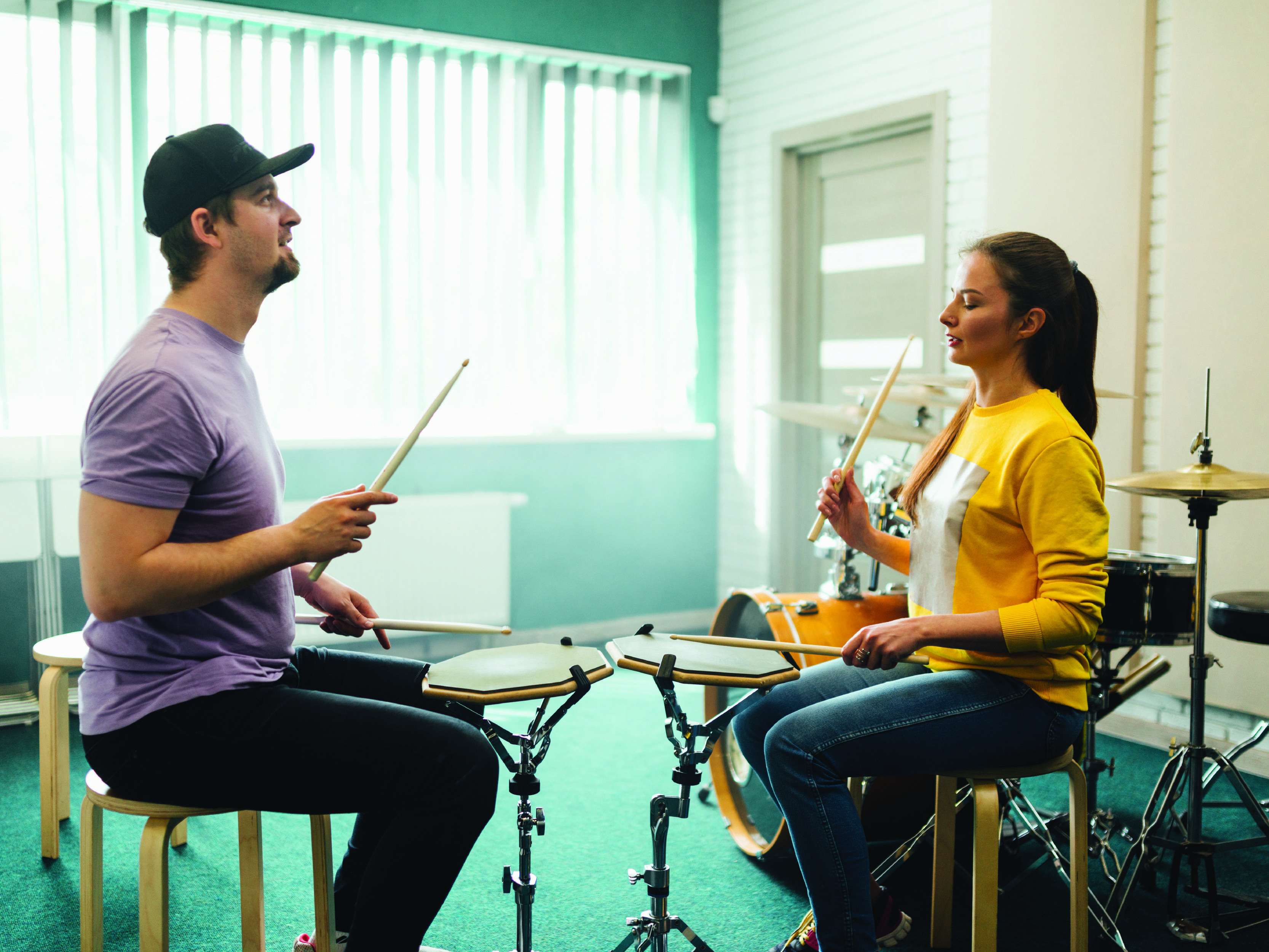
At Music House School Of Music, we believe that learning music should be fun. It never needs to be a set of hard and fast rules. We believe it’s essential to learn drum notation to accelerate your musical journey. With patience, daily practice, and breaking rhythms into smaller parts, you can understand every nuance of drum sheet music. Soon, you will be able to comprehend even the most complex of the grooves. Remember, every skilled drummer was once a beginner who also got confused looking at those dots and Xs.
For those looking to truly master drumming, contact us at Music House School Of Music. We’ll help you discover your true potential and become a pro drummer in no time.